Seacliff
The TrenchThe Seacliff is the United States Navy submersible at the center of the defining catastrophe in Jonas Taylor’s past. On a classified dive nearly seven miles beneath the surface of the Mariana Trench, it brought Jonas face to face with a Megalodon and carried two scientists whose concealed research would later give the accident a second, political significance. Jonas’s emergency ascent saved him from the creature but caused a pressurization malfunction that killed his companions; the submersible thus became both the site of his professional ruin and the point where the novel’s shark story intersects with a hidden contest over fusion fuel.
Identity and Mission
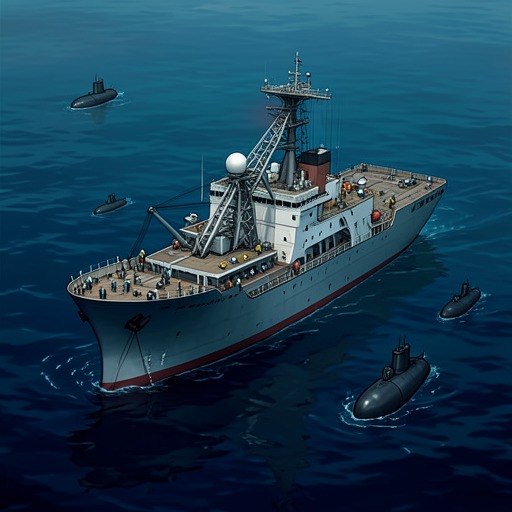
The Seacliff was a three-man submersible piloted by Jonas during a series of top-secret United States Navy dives into the Mariana Trench. The final dive took place at a remote location the crew nicknamed Devil’s Purgatory. Jonas later identified it as a classified mission site and refused to disclose its coordinates, explaining that the Navy was already angry with him. Those coordinates mattered beyond the original expedition: they marked a specific area of the vast trench where valuable manganese nodules could be found.
The mission’s apparent purpose did not tell the whole story. The two scientists aboard were Dick Prestis and Michael Shaffer, both fusion physicists. Unknown to Jonas at the time, they were collecting nodules from the seabed with a long suction device fitted to the Seacliff. Their work was not simply an incidental scientific activity on a deep-sea voyage: the rocks contained a rare mixture of helium-3 and deuterium, which the physicists had discovered could serve as fuel for a sustained fusion reaction. The submersible’s equipment, the secret location, and the scientists’ presence therefore belonged to a concealed search for a potentially consequential energy source.
The Final Dive and Its Consequences
On the last dive, Jonas was exhausted and looking into the black water below when an unfamiliar white glow appeared. He first took it for an aberration, but the shape resolved into a huge, torpedo-headed shark rising toward the Seacliff. The encounter transformed the deep from a setting for technical exploration into an immediate threat. The creature’s appearance overwhelmed Jonas with panic, and he abandoned protocol rather than remain in its path.
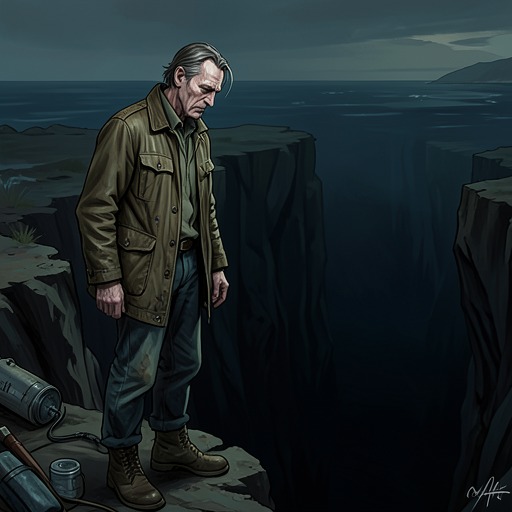
Jonas jettisoned the Seacliff’s ballast and raced toward the surface. The rapid ascent caused a malfunction in the submersible’s pressurization system, and both scientists aboard died. The catastrophe ended Jonas’s career as an argonaut. Its consequences were not limited to the loss of the two men: the decision to flee became the formative failure around which Jonas built years of guilt, fear, and self-reproach. In retrospect, he counted the Seacliff disaster among several occasions when he believed he had failed to act rightly in relation to the Megalodon.
The creature’s presence may also have been linked to the scientists’ equipment. Benedict Singer later suggested that vibrations from the Seacliff’s suction pump might have attracted the Megalodon. This is presented as his suspicion, not a confirmed explanation of the attack. The possibility nevertheless connects the vessel’s practical role in collecting nodules to the danger that ended the dive: a device intended to retrieve material from the seabed may have helped draw the predator toward the submersible.
The Seacliff in Jonas’s Memory
Eleven years after the dive, Jonas continued to interpret his survival as an unresolved debt. He believed he had cheated death aboard the Seacliff and wondered whether he had been meant to die there. That conviction shaped his dreams of descending in an Abyss Glider and meeting Angel in the darkness without escaping. The contrast between the two vessels is significant: the Seacliff belongs to an actual past emergency, while the later deep-sea model in Jonas’s dreams gives that trauma a recurring imagined form. His fear of returning to the trench was therefore bound to the memory of the earlier submersible and to the deaths that followed his ascent.
Jonas also recast the Seacliff incident as one part of a sequence of failures. He blamed himself for the original catastrophe, for trying to capture the Megalodon rather than kill it, and for allowing its offspring to escape. His judgment was not simply that the submersible had failed mechanically; he treated his own decision at the controls as a moral turning point. When he considered whether the Megalodon should have been drowned in the lagoon, the Seacliff returned as the first example in his private accounting of what he had mishandled. The vessel’s place in his memory thus extended well beyond the dive itself: it supplied the origin story for his fear, his guilt, and his belief that survival might have been the wrong outcome.
The Secret Beneath the Disaster
The later revelation about Prestis and Shaffer changes the meaning of the Seacliff expedition without undoing its immediate tragedy. Benedict explained that Prestis and Shaffer had collected about half a dozen nodules before the Megalodon attacked. The United States Navy confiscated the rocks but did not understand their value. Benedict eventually obtained some of the particular nodules and identified the gases trapped inside them as a fusion-fuel mixture. In his account, the scientists had carried their secret to the grave, leaving the precise location of the deposits known to only a small group of naval officers and the Seacliff’s pilot.
That knowledge became a route back to Devil’s Purgatory. Benedict claimed that Jonas had revealed the coordinates to his protégée, Celeste Singer, who persuaded him to share them. Later, Commander Adams and Dave Ross connected the Seacliff dive, the deaths of the two fusion physicists, and the remaining manganese nodules. Their analysis identified inert gases in the rocks as the fusion fuel, and knowledge of the deposit’s location led to preparations for remote mining robots. The Seacliff therefore links an old classified disaster to a new strategic effort: the vessel that carried Jonas into the trench also carried the scientists whose collected evidence made the trench a contested source of energy. Its decisive significance lies in that double legacy, as the origin of Jonas’s trauma and the hidden beginning of the struggle over the nodules.